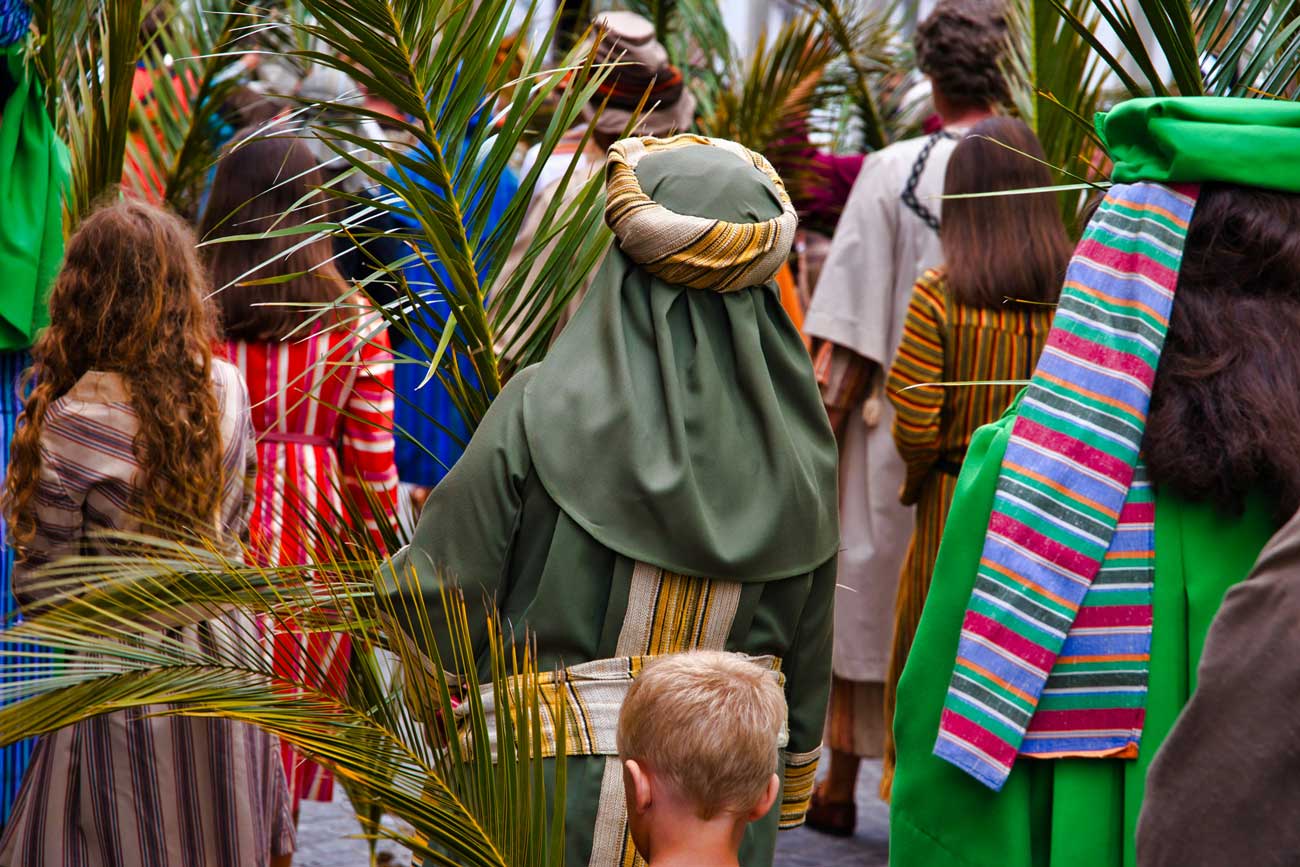
Palm branches waving. A huge crowd shouting “Hosanna!” It looks like a celebration. But five days later, that same crowd would scream, “Crucify him!” What happened in between? And what does Hosanna mean, anyway?
The crowd expected Jesus to fight one war. He came to win another. They wanted a king to overthrow Rome. Jesus came to defeat the real enemy, sin, and to set people free forever. If we are honest, we still make the same mistake today.
This post comes from Hosanna, the first message in our series Pascha, which walks through the final week of Jesus’ life. Pascha refers to the Paschal Lamb, the Passover Lamb, the Lamb of God who takes away the sin of the world. Pascha is Jesus.
If you only have a minute:
- Hosanna means “save now.” It is a cry for rescue taken from Psalm 118:25.
- The crowd misread Jesus. Their palm branches pointed to a military victory. His donkey pointed to peace.
- Our real war is not with people. It is against sin and the spiritual forces of evil (Ephesians 6:12).
- Jesus already won. He is the Lamb of God who takes away the sin of the world.
The world Jesus walked into
To feel the weight of this moment, you have to picture the scene. The world sat in darkness. God had been silent for about 400 years. Roman oppression covered the land like dust. Worst of all, religion had become empty: a form of godliness without its power. The very thing that might have helped people only confined and confused them. Can your heart get there? Does it sound a little like today?
Then Jesus came, born in an ordinary town to ordinary parents. He came on a mission, with love in His veins and victory in His hands. Long before He arrived, the prophet Isaiah described His resolve:
“Because the Sovereign Lord helps me, I will not be disgraced. Therefore have I set my face like flint, and I know I will not be put to shame.” (Isaiah 50:7)
Luke tells us that when the time came, Jesus “set his face to go to Jerusalem” (Luke 9:51, ESV). It was safer in the north, where His following was large and growing. So why was He so determined to go to Jerusalem? Because He is the Lamb of God, heading there with His eyes wide open to die for our sins. There is no greater love in the universe than this.
The triumphal entry
On the way, Jesus passed through Jericho, where He met Zacchaeus, and spent one last night in Bethany, where He was anointed with oil. Then came the day we now call Palm Sunday:
“The next day the great crowd that had come for the festival heard that Jesus was on his way to Jerusalem. They took palm branches and went out to meet him, shouting, ‘Hosanna!’ ‘Blessed is he who comes in the name of the Lord!’ ‘Blessed is the king of Israel!’ Jesus found a young donkey and sat on it, as it is written: ‘Do not be afraid, Daughter Zion; see, your king is coming, seated on a donkey’s colt.’” (John 12:12-15)
The festival was Passover, when Jewish families remember how God delivered them from slavery in Egypt. The city was packed. The Jewish historian Josephus recorded that one year a count of the Passover lambs reached 256,500, which gives you a sense of how many people filled the streets.
Jesus came from the east, over the Mount of Olives across from the Temple, down into the Kidron Valley and up into Jerusalem. The whole way, people waved palm branches and shouted. Think of a ticker tape parade for a hero, except with palm branches.
What does Hosanna mean?
So what does Hosanna mean? It is an exclamation of praise, often translated “save now” or “save, please.” It comes from a Hebrew expression in Psalm 118:25. That psalm was part of the Hallel, Psalms 113 to 118, which were sung during Jewish festivals like Passover.
“Lord, save us! Lord, grant us success!” (Psalm 118:25)
When the crowd shouted Hosanna as Jesus entered Jerusalem, they were expressing their hope for deliverance and recognizing Him as the promised Messiah, the Savior God had promised to send.
Hosanna, then crucify
Now fast forward five days. Pilate, the Roman governor, found no basis for the charges against Jesus and wanted to release Him.
“Wanting to release Jesus, Pilate appealed to them again. But they kept shouting, ‘Crucify him! Crucify him!’” (Luke 23:20-21)
Crucifixion was the Roman death penalty, known for its extreme cruelty and public humiliation. It was usually reserved for slaves, criminals and enemies of the state. Hosanna means “save now.” Crucify means “we want to humiliate you until you die.” It is easy to want to yell at that crowd, until we realize they were not the last people to honor God with their lips while turning from Him in their hearts.
Here is the part that should leave our jaws on the floor. The very people shouting “Crucify” would be the ones to receive the benefits of His death. They did not know it, but Jesus did, and He did not waver. He loved them, and He knew He was not fighting against them.
So what does Hosanna mean for us today? Which word are you shouting, not with your lips but with your life? If you need saving, a lifeline, then with all your being cry Hosanna. Live Hosanna. And the way to live it is to fight the same fight as Jesus.

Why did they wave palm branches?
Today the palm branch points us to Jesus, but to that crowd it meant something else. It was a sign of national pride. In 164 BC, during the Maccabean revolt, Jewish fighters won freedom from a foreign ruler for a time, and the people celebrated with palm branches. Now they were waving them again. Who did they think Jesus was? Another conquering king.
A king on a donkey
Those who come to make war ride horses. Those who come in peace ride donkeys. Imagine lining the streets for a military parade, and the general who is supposed to save the nation rolls in driving a compact hybrid instead of a tank. To the crowd, Jesus was about their nation. Jesus was about His Kingdom. They were not thinking about the same fight. Paul later captured what Jesus was really doing:
“For though we live in the world, we do not wage war as the world does. The weapons we fight with are not the weapons of the world. On the contrary, they have divine power to demolish strongholds.” (2 Corinthians 10:3-4)
If they expected one thing while Jesus was up to another, is it possible that is still true today? We want Jesus to win the war in our marriage, our finances or our minds. We want Him to fix world hunger and political problems. But is that the fight He came to win?
The war Jesus came to win
The crowd wanted freedom from Roman oppression while staying under the penalty of sin. They were selling Jesus short. He came with power to set them free from spiritual strongholds forever, and they wanted temporary relief from Rome.
It would be like asking Leonardo da Vinci to paint your bathroom with one coat of white paint, or inviting Billy Graham to your church to pray over the sprinkler system. Jesus could say to us, “I can do so much more than this. I don’t think you know what I came to do.” And that is probably because we don’t know what we are truly up against.
Name the real enemy
“For our struggle is not against flesh and blood, but against the rulers, against the authorities, against the powers of this dark world and against the spiritual forces of evil in the heavenly realms.” (Ephesians 6:12)
You are not at war with a politician, your spouse, your neighbors or your boss. We are at war with sin, which rages within us. Sin brings death and pain into every area of life, and that is the issue that must be dealt with. When we name our problem accurately, we can find the right solution.
A bucket can’t fix a hole in the boat
The solution for a sinking boat is not a bucket, because the problem isn’t the water in the boat. It is the hole in the boat.
- Got money problems? Before you try to get more money, get right with Jesus. The deeper problem is not a lack of money but a lack of faith.
- Got relationship problems? Start by getting right with Jesus. The deeper problem is not a lack of communication but a lack of communion.
- The crowd’s problem was not Roman rule. It was the power of Satan and the results of sin.
That was the issue then, and it is the issue now: we don’t know our true need. The solution is Pascha, the Lamb of God. It is what John the Baptist said from the very beginning:
“Look, the Lamb of God, who takes away the sin of the world!” (John 1:29)
What this means for you
Fight the same fight as Jesus. Don’t only ask Him to fix what is around you. Ask Him to deal with what is in you. Name the real enemy, which is not the people in your life but sin. Then surrender to the only Savior who has ever defeated it. Let Hosanna be the cry of your life: save me now, Jesus.
Jesus didn’t come to upgrade your old life. He came to trade your shame for forgiveness, your fear for peace and your sin for freedom. He came to save, now and forevermore. Hosanna. To go deeper, read three tricks the devil uses against you and how to defeat them and what it really means to follow Jesus. You can read the whole story of the triumphal entry in John 12 on Bible Gateway.
Wherever you are today, there is a next step. If you want to know more about who Jesus is, start here. If you need someone to pray with you, reach out to our prayer and care team. And if you live near Kissimmee, Florida, we would love to see you on a Sunday.
Frequently Asked Questions About What Does Hosanna Mean
What does Hosanna mean in the Bible?
Hosanna is an exclamation of praise often translated “save now” or “save, please.” It comes from a Hebrew expression in Psalm 118:25: “Lord, save us!”
Why did the crowd wave palm branches for Jesus?
Palm branches were a sign of national victory. They had been used to celebrate after the Maccabean revolt in 164 BC, so the crowd likely saw Jesus as another conquering king who would free them from Rome.
Why did Jesus ride a donkey into Jerusalem?
Those who came to make war rode horses, and those who came in peace rode donkeys. John 12:15 also shows it fulfilled Scripture: “See, your king is coming, seated on a donkey’s colt.”
Why did the same crowd shout Hosanna and then Crucify?
They expected Jesus to fight Rome for their nation. He came to defeat sin and bring His Kingdom, and within five days the crowd was shouting “Crucify him!” (Luke 23:21).